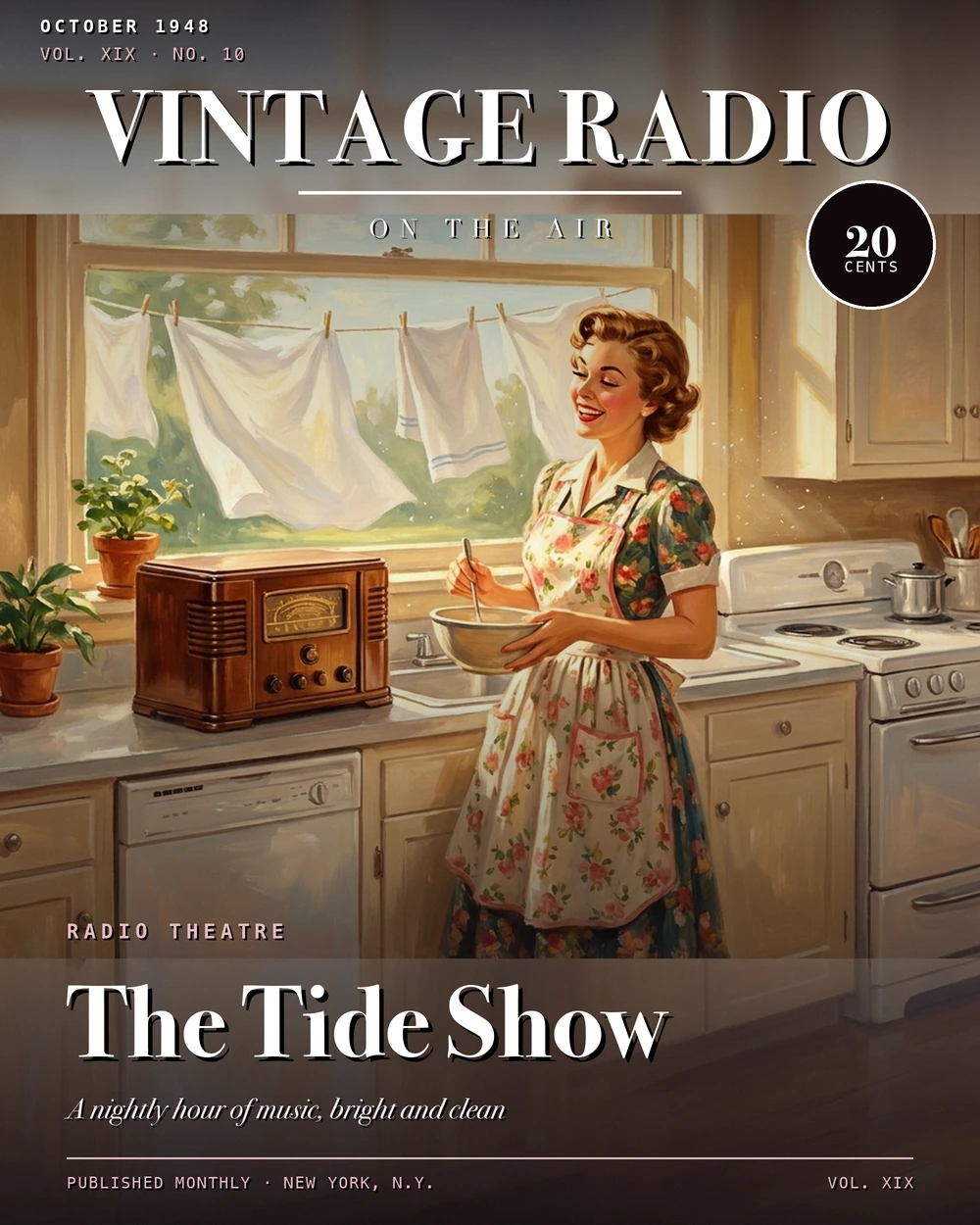
The Tide Show
Where the Music Met the Suds
The Tide Show had an unusual job to do. Every weekday evening, for roughly fifteen minutes, it had to deliver genuine musical entertainment while also selling laundry detergent — and it managed both without making either feel like an afterthought. Sponsored by Procter & Gamble's Tide brand, the program blended popular songs, light comedy, and cheerful commercial pitches into a compact, nightly package that ran from 1945 through 1952. Announcer John Jacobs opened each broadcast the same way, rattling off the brand's signature slogan: "T-I-D-E Tide! The Wash Day Miracle!" — and then the music began.
The format was musical variety, built around live performances from popular soloists and ensemble numbers by a regular cast. Comedy skits and between-song banter kept things moving and gave the writers room to weave in advertising for Tide and other P&G products without stopping the show cold. Tide's jingles and clever lyrics carried the commercial message while still sounding like something you'd actually want to hear. The whole thing closed with a musical sign-off reminding listeners, "The same time, the same place, tomorrow night" — a simple, effective hook that gave the show a nightly appointment feel.
The Cast and the Music
The program was built around a nucleus of well-known performers, and the names attached to it carried real recognition with 1940s and early 1950s audiences. Vocalist "Smiling Jack" Smith was a regular presence, as were Dinah Shore and Ginny Simms — three performers whose styles complemented each other without overlapping. Shore was already established as one of the most popular female vocalists in American radio by the time the show was running, and Simms had built her name through work with Kay Kyser's orchestra before striking out as a soloist. Smith, warmly nicknamed for his easygoing style, was a fixture on the West Coast radio scene.
Beyond the regulars, the show rotated in guest performers who appeared alongside the core cast, mixing rising talents with established stars. Each episode organized its songs as solos, duets, or ensemble numbers, and the catalog of surviving episode entries gives a sense of the repertoire: opening numbers included "A Foggy Day In London Town," "The Lullaby Of Broadway," "In The Cool Cool Of The Evening," "Brazil," and "Dream," among others. The variety was genuine — the show moved between romantic standards, novelty numbers, and Latin-inflected material without settling into a single lane.
Frank De Vol and the Orchestra
Running the musical side of the operation was Frank De Vol, who served as the show's musical director. De Vol, born September 20, 1911, had settled in California in 1943 and quickly built a reputation as an arranger and bandleader on the West Coast radio circuit. He started leading a band on KHJ radio, providing accompaniment on a number of programs before landing in more prominent roles. By the time the Tide Show was in production, he had already worked as musical director for Ginny Simms, Rudy Vallée, Jack Smith, and Dinah Shore — which meant the core cast of the Tide Show were performers he already knew, and that familiarity showed in the sound.
De Vol's orchestra provided the opening and accompanying music throughout each episode, and his arrangements were also syndicated through Capitol Transcriptions, for which he served as musical director as well. He was, by the early 1950s, a remarkably busy figure in West Coast broadcasting. His work on the Tide Show was one thread in a much larger career that eventually extended into film scoring and television, but his radio years — and this program in particular — represent a sustained collaboration between a skilled arranger and a strong cast of vocalists.
The Sponsor Behind the Show
Tide detergent was a relatively new product when the show began. Procter & Gamble introduced it to U.S. test markets in 1946, positioning it as the world's first heavy-duty synthetic detergent, and completed nationwide distribution in 1949. The product launched with a $21 million advertising budget and moved fast — it outsold P&G's own established brands, Oxydol and Duz, in short order. For a company that had helped invent the soap opera format by sponsoring daytime serials as far back as 1933, radio advertising was not new territory. The Tide Show was a natural extension of P&G's long-standing approach to broadcast sponsorship: put your product's name on entertainment that people actually seek out, and let familiarity do the rest.
The show's approach to integration was lighter than a hard-sell commercial break. Jingles, clever lyrics, and the banter between sketches kept Tide's name in the air without grinding the music to a halt. It was a format well suited to a product whose buyers were tuning in every weekday evening and could hear the brand associated with something genuinely enjoyable, night after night.
The Hollywood Years
From 1948 onward, the show broadcast from the Music Box Theatre on Hollywood Boulevard, which gave it both a physical home and a small-scale prestige that fit the program's style. The Hollywood location put the show near the talent pool that fed it — the West Coast music and radio scene that De Vol had been working in since 1943 — and the Music Box's intimate setting suited a fifteen-minute program better than a large auditorium would have.
The episode catalog contains 22 known episodes, all falling between August 27, 1951, and November 9, 1951, which represents the latter portion of a run that stretched back to 1945. The full documented run accounts for approximately 86 recordings and a total playtime of around 20 hours and 35 minutes — figures consistent with the show's fifteen-minute format broadcast every weekday evening. That kind of daily output, sustained over years, reflects how routine and professionally managed the production was. This was not a showcase event or a special broadcast; it was a working program that showed up five nights a week and delivered its quarter-hour of music and selling on schedule.
What the Show Represents
The Tide Show fits naturally alongside other musical variety programs of the same era — comparable in spirit to the Andrews Sisters' radio work or Glenn Miller's broadcasts — but it occupied its own specific niche as a sponsor-driven daily program rather than a weekly entertainment showcase. Its fifteen-minute format, nightly schedule, and tight integration of product and performance made it something closer to a branded musical feature than a traditional variety hour.
The first-song structure of each episode — the catalog entries are organized by opening number — suggests the production team understood that the first few minutes set the tone for everything that followed. A strong opening number pulled listeners in quickly, and in a fifteen-minute show, there wasn't time to ease into things. The range of songs that served as openers, from Broadway standards to novelty material, points to a program that took its musical choices seriously even within the constraints of its commercial purpose.
The show ended in 1952, closing out a seven-year run that tracked almost exactly with Tide detergent's rise from regional test product to national market leader. Whether that parallel was coincidence or the natural end of a campaign that had accomplished what it set out to do, the Tide Show left behind a documented body of work — nightly music, professional performances, and one of the more memorable sign-offs in weekday radio.